


Mini-Court, Big Skills: The Techniques You Can Polish in a Smaller Playing Area
Less space doesn't mean less game. Some of the most important skills in pickleball are best learned in close quarters.
There's a common assumption among players considering a backyard court that if the space isn't full regulation size, it isn't worth building. That assumption is worth examining, because it misunderstands where pickleball is actually won and lost.
The most decisive moments in pickleball happen within the first twenty feet from the net. The kitchen, the transition zone, the soft game exchanges that build pressure and create openings — all of it unfolds in a compact space where touch, timing, and reading your opponent matter far more than raw court coverage. A smaller playing area doesn't limit your development. In many ways, it accelerates it.
Here's what you can genuinely sharpen on a mini-court, and why some of the world's best players deliberately train in reduced spaces.
Understanding What a Mini-Court Actually Is
A mini-court in pickleball typically refers to a scaled-down playing area centered on the kitchen and the zone immediately behind it. The most common format uses the kitchen lines as the baseline, meaning both players are restricted to the non-volley zone and the area just behind it. Some variations extend slightly further back but still operate at a fraction of full-court depth.
This format isn't a compromise. It's a deliberate training environment used at every level of the game, from beginner clinics to professional practice sessions. The constraints it imposes force players to develop skills that are easy to neglect on a full court, where there's always the option of resetting with a deep lob or retreating to the baseline.
On a mini-court, there's nowhere to hide. Every shot has to be intentional.
The Kitchen Game: Where Matches Are Decided
Pickleball's non-volley zone, the kitchen, is unlike anything in tennis or badminton. It creates a dead zone that forces players into a soft game exchange at the net that rewards patience, precision, and disguise over power. It is, by most advanced players' reckoning, the most skill-intensive part of the game.
A mini-court is essentially a kitchen game simulator. Every rally begins and ends in the zone that matters most, which means every session builds the specific muscle memory and decision-making that translates directly to match performance.
Dinking. The dink is the foundational shot of the kitchen game: a soft, controlled shot that clears the net and lands in the opponent's kitchen. On a full court, players often under-practice dinking because it feels less satisfying than a powerful drive. On a mini-court, it becomes the primary language of the game. Players develop feel, touch, and the ability to vary pace and angle in ways that only come from repetition in a focused environment.
Cross-court dinking. The cross-court dink is a staple of high-level play because the geometry of the court gives it a natural advantage: more net clearance, a longer diagonal distance, and a lower risk of error. Mini-court sessions naturally emphasize this shot and develop the consistency that makes it a reliable weapon under pressure.
The speedup and reset. One of the most important skill sequences in pickleball is the ability to initiate a fast exchange and, when the opponent responds with pace, to reset the ball softly back into the kitchen. This requires exceptional hand speed, controlled touch under pressure, and the composure to choose the reset when instinct says to hit harder. The mini-court is the ideal environment to develop this sequence because speedups and resets happen constantly, with no room for the game to open up into anything else.
Volleys and Hand Speed
At the net, pickleball can move extraordinarily fast. The exchange of quick volleys that develops in a tight kitchen battle tests reflexes, racquet preparation, and the ability to keep the ball low while still generating pace.
Mini-court play accelerates the development of these skills because volleys happen in higher volume and at closer range than in full-court play. There's less time to prepare, which forces players to simplify their technique, shorten their backswing, and rely on compact, efficient mechanics that hold up under pressure. Those mechanics, once groomed in a mini-court environment, translate directly to full-court play.
Punch volleys. The punch volley, a short, forward stroke that redirects pace rather than generating it from scratch, is one of the most reliable shots in close-quarters pickleball. Mini-court sessions develop the feel for this shot naturally because soft hands and accurate placement win far more exchanges than raw power.
Block volleys. When an opponent speeds up from close range, the block volley is often the correct response: a passive, angled shot that absorbs pace and drops the ball into the kitchen. This is among the hardest skills to develop because it requires the counterintuitive instinct to go soft when everything about the moment says go hard. Repeated mini-court play builds this instinct through experience that no full-court drill quite replicates.
Footwork and Court Presence
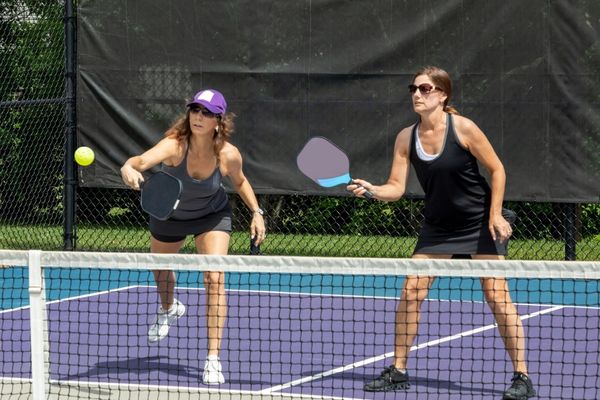
One of the quieter benefits of mini-court training is what it does for footwork. On a full court, poor footwork can be masked by athleticism or by simply having more time to recover. In a compact space, balance, weight transfer, and positioning become immediately visible.
The split step, the small preparatory hop that resets a player's weight before each opponent shot, is one of the most fundamental athletic movements in racquet sports. Mini-court play develops it naturally because the pace of exchanges leaves no room for flat-footed responses. Players who train regularly in smaller spaces develop an instinctive readiness that makes them faster and more balanced on the full court.
Lateral movement patterns also sharpen significantly. The ability to cover the kitchen line efficiently, to slide rather than lunge, and to recover position quickly after each shot is built through the kind of high-repetition, fast-paced exchange that mini-court play produces.
Patience and Tactical Thinking
Perhaps the most underrated thing a mini-court develops is the mental side of the game.
Full-court pickleball offers many ways to end a point: a powerful third-shot drive, a deep lob, an aggressive put-away from mid-court. Mini-court play removes most of those options. To win a point, you have to construct it, through placement, variation, disguise, and the patience to wait for an opening rather than forcing one.
This is the game within the game that separates intermediate players from advanced ones. And it's a quality that is genuinely difficult to develop through full-court play alone, because the full court offers too many shortcuts. The mini-court takes those shortcuts away and rewards only the players willing to think two or three shots ahead.
Patterns and sequencing. Advanced players don't just hit one good shot. They set up the next shot with the current one, using placement and pace to move the opponent out of position before finishing. Mini-court play is an excellent environment to practice this kind of pattern play because the compressed space makes the consequences of each shot immediately visible.
Disguise and deception. When the game is slow and close, the ability to make two different shots look identical becomes enormously powerful. The same grip, the same preparation, the same body position, and then a sudden change of direction or pace. Mini-court sessions create the conditions for this kind of deception to develop because they force players to find ways to win without relying on pace.
Designing a Mini-Court Space
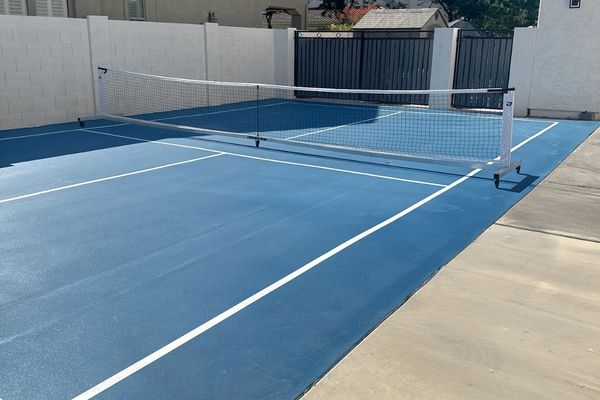
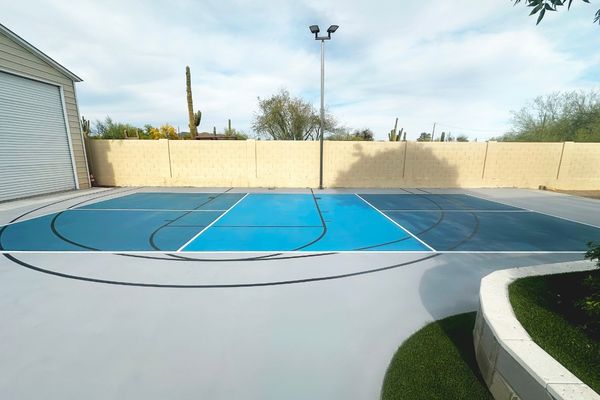
If you're working with a smaller footprint than a full regulation court, the news is genuinely good. A space as compact as 20 by 44 feet, or even smaller for pure kitchen practice, can support meaningful, structured training sessions that build real skills.
For homeowners in Scottsdale exploring what's possible in a side yard, a pool deck perimeter, or a modest backyard, a properly surfaced mini-court is far more versatile than it first appears. The right surface coating, accurate kitchen and centerline markings, and a regulation net are all that's required to create a training environment that can meaningfully accelerate your game.
The kitchen dimensions are the same regardless of court size: 7 feet deep on each side of the net, 20 feet wide. Get those right, and you have everything you need to practice the part of pickleball that matters most.
At Just Pickle Courts, we design courts for the space you actually have, not just the space an ideal specification assumes. Whether that's a full regulation court or a compact training area built around the kitchen game, the result should feel intentional, play beautifully, and fit the way you actually want to use it.
We'd love to help you bring the court home. Contact us to schedule a complimentary, no-obligation consultation today.
Interested in more pickleball content? Follow us on Instagram.