


Recreational Court Planning for Facilities: Everything You Need to Know
Pickleball is no longer an amenity health clubs can afford to overlook. Membership surveys across the country consistently rank pickleball courts among the most requested additions to fitness facilities, and clubs that have added courts are reporting measurable increases in membership retention, new member acquisition, and court booking revenue.
But building courts for a health club or fitness facility is a different project than building a backyard court. The stakes are higher, the usage is heavier, and the decisions made before the first shovel goes in the ground have a direct impact on member experience, operational efficiency, and long-term return on investment.
Here is everything your facility needs to consider before you build.
Start With Your Member Base, Not the Sport
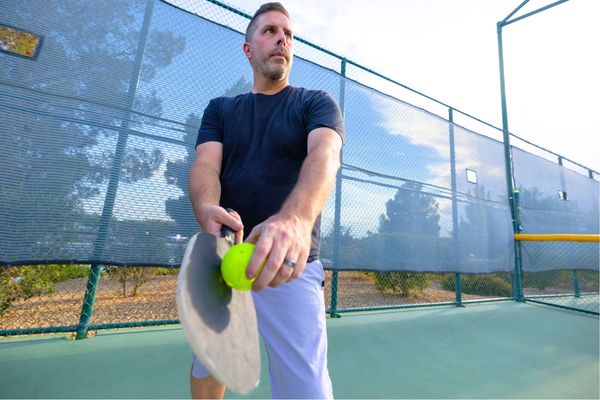
Before any site planning or contractor conversations happen, spend time understanding who in your membership is already playing pickleball, who is interested but hasn't started, and what level of programming your facility intends to offer.
A facility that wants to host beginner clinics and social mixers has different court requirements than one planning to run competitive leagues and sanctioned tournaments. The number of courts, the lighting system, the spectator capacity, and the surface specification all flow from that decision.
Getting clear on your programming vision before you plan the space saves significant time, money, and frustration during the build process.
How Many Courts Does Your Facility Need
For most health clubs entering the pickleball space, the question isn't whether to build courts, it's how many to start with and how to plan for growth.
A single court is rarely the right answer for a facility with serious programming ambitions. One court creates immediate bottlenecks during peak hours, limits your ability to run structured programs, and generates member frustration faster than almost any other capacity issue.
The general planning benchmarks worth knowing:
For a facility with 2,000 to 5,000 active members, two to four courts give enough capacity for open play, beginner programming, and casual league play without creating excessive wait times during peak periods.
For larger facilities or those with dedicated pickleball programming, four to eight courts allow for simultaneous open play and structured programming, tournament hosting, and the kind of court availability that becomes a genuine membership differentiator.
The critical planning note is to design the site for your eventual court count, even if you build in phases. Running electrical, conduit, and drainage infrastructure for eight courts during a four-court build costs a fraction of what retrofitting it later would require.
What to Consider Before Building
Site Selection and Orientation
For outdoor facilities, court orientation matters more than you might think. A north-south orientation minimizes direct sun in players' eyes during morning and evening play, which in Arizona's climate is when the majority of recreational play happens. Courts oriented east-west put the rising or setting sun directly in players' sightlines during peak usage hours, which creates safety concerns and member complaints that are entirely avoidable at the planning stage.
Wind exposure is equally important for outdoor courts. A site assessment that evaluates prevailing wind patterns helps determine whether windscreens or natural barriers are needed, and where to position them without restricting airflow that players appreciate in warm weather.
Spacing and Layout
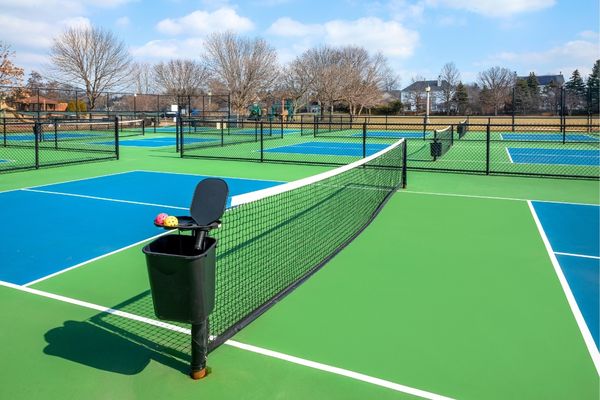
The minimum recommended buffer between adjacent courts is ten feet. For a health club environment with high traffic volume and mixed skill levels, more is better. Courts that are too close together create constant ball interference between games, increase safety incidents, and generate the kind of friction between members that facility managers spend significant time managing.
Beyond court-to-court spacing, plan generously for the surrounding circulation areas. Players warming up, waiting for courts, coaching sessions, and spectators watching league play all need space that doesn't conflict with active games.
Surface Selection
For health club and facility use, surface selection is one of the most consequential decisions in the planning process. A properly constructed post-tension concrete base with a professional acrylic coating system is the industry standard for good reason; it is durable, consistent, can be resurfaced, and performs predictably across a wide range of temperatures and usage levels.
In Arizona's climate, the surface specification needs to account for UV exposure, extreme heat, and the expansion and contraction cycles that come with dramatic temperature variation. A post-tension concrete base handles these conditions better than a standard rebar slab over the long term, which matters significantly for a facility that cannot afford extended court closures for repairs.
Cushioned acrylic systems are worth considering for facilities that serve older adult populations or members with joint concerns. The added surface cushioning reduces the impact load on knees, hips, and ankles during extended play sessions, which increases the amount of time members spend on the court and reduces the likelihood of usage-related attrition.
Drainage Planning
Standing water on a court after rain is not just an inconvenience; it is a liability. A properly engineered drainage system with verified slope during the pour ensures courts drain completely and quickly, minimizing the window between rain events and playable conditions.
For facilities that track court utilization as a revenue metric, drainage quality has a direct financial impact. Courts that drain in thirty minutes after a monsoon rain are available for more booking hours per year than courts that pool and require manual clearing.
Designing for Multiple Users
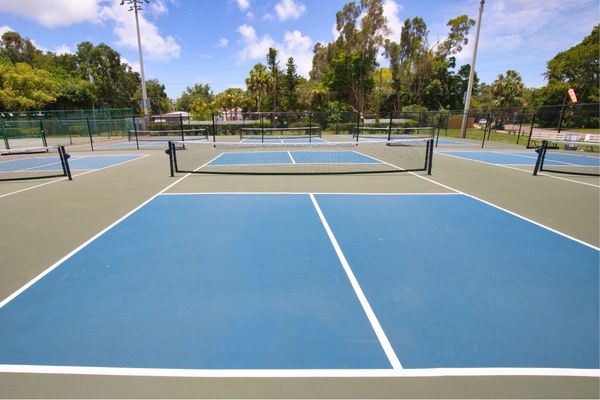
Health club pickleball courts serve a more diverse user population than almost any other sport facility. Beginners sharing court time with intermediate players, older adults playing alongside younger members, recreational players mixing with competitive ones, the design decisions that manage this diversity well are the ones that keep all of those members happy simultaneously.
Skill-Based Court Designation
As your facility grows its pickleball programming, designating courts by skill level during open play periods dramatically reduces the friction that comes from mixed-skill play. This doesn't require separate physical spaces; it requires clear signage, a consistent scheduling policy, and staff who understand how to enforce it diplomatically.
Planning for this from the start means building the court numbering and signage infrastructure into the original design rather than retrofitting it later.
Divider Netting
Without netting, stray balls interrupt adjacent games constantly during busy periods. With netting, courts function as independent playing environments regardless of what is happening on either side.
For facilities running simultaneous programs, open play on some courts, a clinic on others, netting also provides a visual and acoustic separation that helps both groups stay focused.
Spectator Areas
Pickleball is a spectator-friendly sport, and facilities that account for this in their design create a social atmosphere that becomes a genuine membership draw. Designated seating with clear sight lines to multiple courts gives non-playing members somewhere comfortable to watch, wait, and socialize, which increases overall time spent at the facility and strengthens the community feel that drives retention.
For facilities planning to host leagues or tournaments, spectator capacity becomes a programming requirement rather than a nice-to-have. A tournament that cannot comfortably accommodate spectators is a tournament that underperforms as a membership event and generates less social media content than one that feels like a real venue.
Shade and Weather Protection
In Arizona, shade is not optional for outdoor facilities. Courts without adequate shade coverage become functionally unusable during a significant portion of the year, which directly limits the return on your court investment.
Shade structures positioned to cover spectator and waiting areas, rather than the courts themselves, where overhead coverage can interfere with lob shots, extend the usable hours of outdoor facilities dramatically. Combined with well-designed evening lighting, a shaded outdoor facility in Scottsdale or Phoenix can realistically operate comfortably for ten or more hours per day for the majority of the year.
Cost and Planning Overview
The investment range for professionally built pickleball courts at the facility level varies significantly based on the number of courts, surface specification, lighting, shade infrastructure, and site preparation requirements.
A single professionally built outdoor court with standard lighting runs between $25,000 and $45,000, depending on foundation type and surface specification. Multi-court builds benefit from economies of scale in labor, materials, and site preparation; the per-court cost typically decreases meaningfully as court count increases.
The factors that most commonly cause facility projects to exceed initial budget projections are site preparation surprises discovered after work begins, lighting and electrical infrastructure that wasn't fully scoped in the original plan, and phased builds that require retrofitting infrastructure that should have been installed during the initial construction.
Working with a court installer who conducts a thorough site assessment, documents all pre-construction decisions, and plans infrastructure for your eventual court count rather than just your initial build is the most reliable way to keep a facility project on budget and on schedule.
The Revenue Case
Court rental rates in the Scottsdale and Phoenix market currently run between $15 and $30 per person per hour for facility open play, with premium rates for reserved court time and programming sessions. A four-court facility running at moderate utilization during peak hours generates meaningful incremental revenue while simultaneously increasing membership value perception, the kind of amenity that shows up in both acquisition conversations and renewal decisions.
The facilities that are seeing the strongest return on their pickleball investment are the ones that treated the build as a programming decision, not just a construction project. Courts that sit underutilized because no programming infrastructure was built around them generate a fraction of the revenue and member value of courts embedded in a thoughtful activity calendar.
Working with the Right Court Installer
A health club or facility court build is not a project for a general contractor who has built a few residential courts. The complexity of multi-court layout planning, the precision required in drainage engineering, the lighting design for evening programming, and the surface specifications needed to withstand heavy commercial use all require a contractor with documented experience at the facility level.
Questions Worth Asking Any Court Installer You Consider:
How many multi-court facility builds have you completed, and can we see them? What does your documentation process look like for the base and slab? What surface specification do you recommend for our usage level and why? What does your follow-up and warranty process look like after the build is complete?
The answers to those questions tell you most of what you need to know before any contracts are signed.
The facilities that build pickleball courts thoughtfully, with the right surface for their usage, the right number of courts for their member base, and the right infrastructure for the programming they want to run, are the ones seeing pickleball become a genuine competitive advantage in a crowded fitness market.
The courts that get built without that planning discipline become maintenance problems, member friction points, and missed revenue opportunities.
At Just Pickle Courts, we design and build professional-grade pickleball courts for health clubs, fitness facilities, and multi-court venues across Scottsdale and the greater Phoenix area. From initial site assessment through final installation, we build to a documented standard that holds up under commercial use for the long term.
If you are planning a facility build or expansion, we would love to be part of the conversation early. Schedule a consultation, and let's talk about what your facility could be.
Contact us to schedule a complimentary, no-obligation consultation today.
Interested in more pickleball content? Follow us on Instagram.