


Shade Solutions for Pickleball Courts: From Pergolas to Retractable Covers
If you're building or owning a pickleball court in Arizona, shade isn't an aesthetic decision. It's a functional one. The difference between a court that gets used year-round and one that sits empty from May through September almost always comes down to whether players have somewhere to escape the sun between games and whether the court itself is positioned and protected to make play comfortable during the hours that matter.
Here's a complete look at the shade options available for pickleball courts, what each offers, and how to choose the right solution for your specific setup.
Why Shade Matters More Than Most Court Owners Expect
The conversation about shade usually starts with player comfort. That's valid; nobody wants to stand in direct Arizona sun between rallies. But shade does more than keep players cool.
It extends your usable court hours. A shaded seating and waiting area means players stay on site longer, rotate through games more comfortably, and don't cut sessions short because the sun has made everything around the court unbearable.
It protects your court surface. Sustained UV exposure is the primary cause of acrylic coating degradation on outdoor courts. A shade structure that reduces direct sun on the surface during peak hours extends the life of your coating and reduces the frequency of resurfacing.
It makes the space feel intentional. A court with thoughtful shade infrastructure reads as a designed outdoor space rather than a slab with lines on it. For residential courts especially, that distinction matters for how the property is perceived and valued.
Option 1: Pergolas
Pergolas are the most popular shade solution for residential pickleball courts in the Scottsdale and Phoenix area, and for good reason. They're permanent, attractive, and add architectural value to the property beyond their functional purpose.
A well-designed pergola positioned adjacent to the court, covering the seating and waiting area rather than the playing surface itself, gives players a defined space to rest, watch, and socialize without interrupting sightlines or interfering with overhead lob shots.
What to consider: Pergola placement matters significantly. A structure positioned too close to the court boundary can become a visual obstruction during play or create awkward clearance issues for overhead shots. The sweet spot is typically just outside the court perimeter, set back enough to feel like a natural transition between the playing surface and the surrounding outdoor space.
Material choice affects both aesthetics and longevity. Aluminum pergolas require virtually no maintenance and hold up well in Arizona's climate. Wood pergolas offer a warmer aesthetic but require more ongoing care in the heat and UV exposure that the desert provides. Many homeowners in the Valley choose aluminum frames with wood-look finishes as a practical middle ground.
Best for: Residential courts where the pergola can double as a general outdoor living structure. Works especially well when the court is adjacent to an existing patio or pool area.
Option 2: Shade Sails

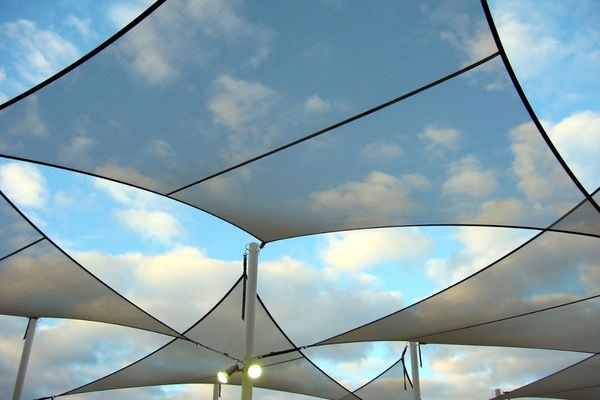
Shade sails are a flexible, cost-effective shade solution that has become increasingly popular for both residential and facility courts. They consist of tensioned fabric panels anchored between posts or existing structures, creating a canopy effect that blocks UV rays while allowing airflow underneath.
Modern shade sail fabrics block up to 95 percent of UV rays while remaining breathable enough to avoid trapping heat beneath them, a meaningful distinction in Arizona, where a non-breathable cover can actually make the space underneath it hotter than the open sun.
What to consider: Shade sails work best when they're sized and positioned to cover specific zones rather than the entire court footprint. A sail covering the seating area and one end of the court provides relief where players spend their downtime without creating overhead obstructions during play.
They require periodic tensioning and should be removed or re-secured before major monsoon events. Most residential shade sail installations in Arizona are designed with seasonal use in mind, installed for the summer season and stored during the cooler months when shade is less critical.
Best for: Courts where budget is a consideration, courts in HOA environments where permanent structures require approval, or as a supplemental shade solution alongside a pergola or existing patio cover.
Option 3: Retractable Awnings and Covers
Retractable shade systems offer the most flexibility of any shade solution — extending when shade is needed and retracting when it isn't. For courts where the shade need varies significantly by season or time of day, retractable systems eliminate the tradeoff between having too much overhead coverage and not enough.
Motorized retractable awnings can be programmed to extend and retract on a schedule, controlled via remote, or integrated with smart home systems. For a court owner who plays both early morning and late afternoon, a retractable system that adjusts to the sun's position throughout the day offers a level of control that fixed structures simply can't match.
What to consider: Retractable systems are generally the most expensive shade option and require professional installation to ensure proper anchoring and tension. In Arizona's monsoon season, retractable covers should be retracted before significant wind events. Most modern systems include wind sensors that trigger automatic retraction when conditions exceed safe operating limits.
The fabric choice matters for longevity. Solution-dyed acrylic fabrics hold their color and structural integrity significantly better than coated polyester options under sustained UV exposure.
Best for: Facility courts where operational flexibility is valuable, or residential courts where the owner wants maximum control over the playing environment throughout the year.
Option 4: Shade Structures and Steel Canopies

For multi-court facilities, HOA courts, or residential builds where permanence and coverage are the primary goals, engineered shade structures and steel canopies offer the most robust solution available.
These are purpose-built structures, typically steel frames with tensioned fabric or polycarbonate roofing panels, designed to cover significant square footage with consistent, durable shade. They're the standard choice for municipal courts, fitness facility outdoor spaces, and resort installations where the shade infrastructure needs to perform without maintenance for years at a time.
What to consider: Engineered shade structures require permitting in most Arizona jurisdictions and should be designed by a structural engineer familiar with local wind load requirements. Arizona's monsoon season produces significant wind events, and a shade structure that isn't engineered for those loads becomes a liability rather than an asset.
The investment is higher than other shade options, but the per-year cost over the structure's lifespan is often comparable to or lower than less permanent solutions that require more frequent replacement or maintenance.
Best for: Multi-court facilities, HOA and community courts, resort and hotel courts, or any installation where the shade infrastructure is expected to perform at a commercial level.
Option 5: Strategic Landscaping
Shade doesn't always require a structure. Strategic landscaping, trees, hedgerows, and tall plantings positioned to block the sun during peak playing hours are an underutilized complement to structural shade solutions that also improve the overall aesthetic of the court environment.
In Arizona, the right plant selection matters significantly. Fast-growing shade trees like Mesquite, Palo Verde, and Desert Willow are well-adapted to the climate, require minimal water once established, and can provide meaningful shade within a few growing seasons.
What to consider: Landscaping shade is inherently less precise than structural solutions; you can't control exactly where the shadow falls or adjust it as the sun moves. It works best as a supplement to other shade infrastructure rather than a standalone solution. Roots from trees planted too close to the court can also compromise the slab over time, so placement relative to the court perimeter requires careful planning.
Best for: Any court where the surrounding landscape can be designed to complement the playing environment, particularly residential builds where the overall yard aesthetic is a priority.
Combining Shade Solutions
The most effective shade setups for Arizona courts typically combine two or more approaches. A pergola or shade structure covering the seating area, shade sails providing supplemental coverage over the waiting zone, and strategic landscaping softening the perimeter create a layered environment that manages sun exposure throughout the day from multiple directions.
Planning these layers during the initial court design phase is significantly more cost-effective than adding them after the fact. Electrical conduit for a motorized retractable system, post footings for a pergola, and irrigation for surrounding landscaping are all easier and cheaper to install before the court is poured than after.
Shade is the investment that makes every other court investment worth more. A court that's comfortable to use twelve months a year generates more enjoyment, more social use, and more return on the build than one that sits idle through the summer.
At Just Pickle Courts, we think about shade, orientation, and the full playing environment as part of every court design, not as an afterthought. If you're planning a court and want to get the shade solution right from the start, schedule your free on-site estimate, and let's design the full picture together.
Schedule your free on-site estimate, and let's start planning.
Interested in more pickleball content? Follow us on Instagram.